There’s a difference between advocacy and responsibility—and right now in Dutchess County, that line is being tested.
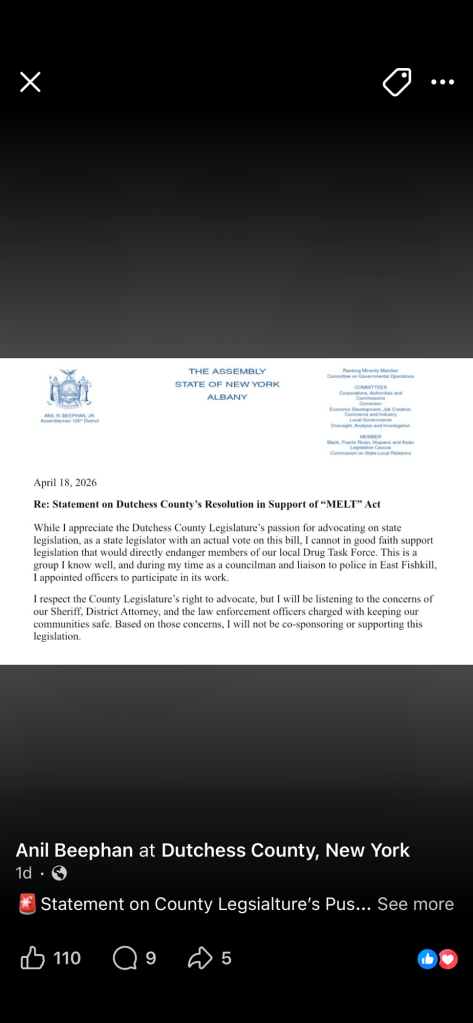
When Anil Beephan Jr. stepped forward and declined to support the Legislature’s resolution backing the “MELT” Act, he didn’t take the easy path. He took the responsible one.
Because what the Dutchess County Legislature has done here goes beyond simply passing a resolution. It has waded into a complex, high-stakes state debate with a broad stroke—one that risks real consequences for the very people tasked with keeping our communities safe.
The resolution leans heavily on the language of transparency—“no masked agents,” “public accountability,” “right to know.” On paper, it reads well. But governing isn’t done on paper. It’s done in the real world, where decisions ripple outward and affect operations, safety, and outcomes.
And that’s where this effort begins to unravel.
The Drug Task Force doesn’t operate in theory. It operates in danger. Its effectiveness depends on discretion, strategy, and yes—at times—anonymity. Strip that away with sweeping mandates, and you don’t just make a philosophical point. You create risk. You compromise investigations. You potentially expose officers in ways that cannot be undone.
Yet the Legislature pressed forward anyway.
Beephan didn’t ignore the call for accountability—he acknowledged it. But he also did something the Legislature appeared unwilling to do: he listened to the people closest to the consequences. Law enforcement professionals. The Sheriff. The District Attorney. The individuals who understand that public safety is not a slogan—it’s a responsibility.
And based on those voices, he made a decision that wasn’t about headlines or political alignment. It was about judgment.
That’s the contrast in this moment.
On one side, a legislative body eager to signal virtue and stake out a position in a broader political debate. On the other, a lawmaker grounded in the realities of how policy actually plays out on the ground.
This isn’t about opposing transparency. It’s about understanding that transparency, when applied without nuance, can undermine the very systems it’s meant to improve.
Not every good-sounding idea is good policy. Not every resolution deserves support.
And sometimes, leadership isn’t about joining the chorus—it’s about having the clarity and courage to stand apart.
That’s exactly what Beephan did.