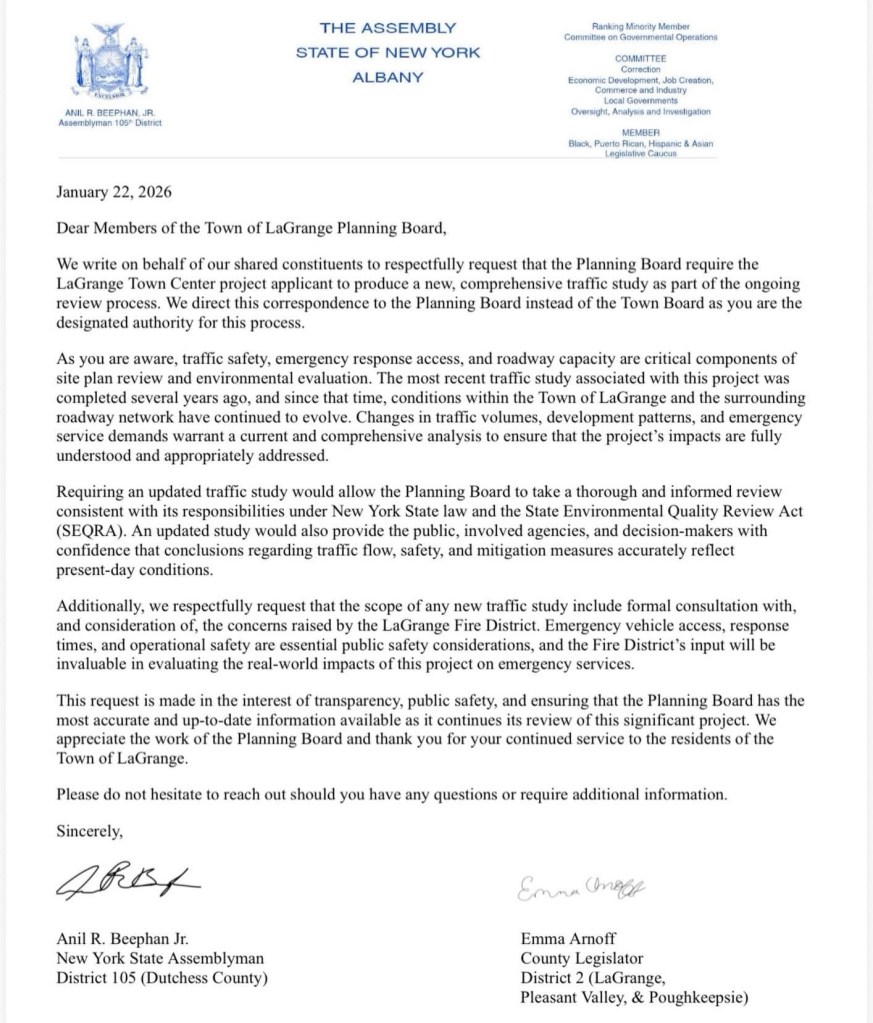
Voters Elect Emma Arnoff to Serve — She Immediately Applies for a Different Job.

The Valley Viewpoint

Only in Dutchess County can someone win an election on Tuesday, announce a run for higher office by Thursday, and walk it all back before the weekend brunch menus hit the table.

Emma Arnoff’s post-election victory lap was so short it needed hazard lights.

She had barely taken her hand off the Bible from being elected to the Dutchess County Legislature when — boom — she decided county government wasn’t big enough to contain her destiny. Albany beckoned. Why spend even a single term learning the job voters just gave you when you can leapfrog directly into a State Senate race?

For about 15 minutes, Arnoff was running for NYS Senate. Rob Rolison probably hadn’t even finished his morning coffee before learning he suddenly had a new challenger — and then, just as suddenly, didn’t.

Because after a burst of headlines and raised eyebrows across the county, Arnoff hit the political “undo” button and declared, with great seriousness, that she would now be focusing on the seat she just won. As if this had all been a harmless little whoopsie — like accidentally sending a text to the wrong group chat, except the “text” was a Senate campaign.

It left voters wondering:
Did she misunderstand which office she ran for?
Did she think the County Legislature was an orientation seminar for Albany?
Or was this the political equivalent of checking Zillow for mansions you have no business buying?

Look — ambition is fine. We all like people with goals. But maybe, just maybe, you should serve a day in the job before announcing the next one.

Arnoff’s 72-hour Senate sprint wasn’t a campaign; it was a trial balloon that burst on takeoff. And it confirmed something voters already suspect: too many of our young political stars are more interested in climbing than serving.

In Dutchess County, we’ve seen quick rises, dramatic falls, and everything in between. But Emma Arnoff may have set a new record:

Fastest transition from “I’m honored to serve” to “I’m out of here.”

Welcome to local politics — where the ambition is sky-high, and the attention span… not so much.

NY ’s “Obedient”Governor

A Valley Viewpoint Narrative:

Kathy Hochul’s Leadership Crisis — Or Who’s Really Running New York?

Every now and then, a political story comes along that doesn’t just raise eyebrows — it raises a far deeper question: Who exactly is in charge?

That’s the question at the center of Michael Goodwin’s blistering op-ed in the New York Post, and frankly, it’s a question more and more New Yorkers are asking about Governor Kathy Hochul.

According to federal prosecutors, one of Hochul’s own senior aides — Linda Sun — now faces charges for allegedly acting as a covert agent for China. That’s shocking on its own. But the real stunner? Sun reportedly described Hochul as “obedient” and “easier to influence” than Andrew Cuomo.

Think about that. A governor of the largest, most complicated state in America being labeled “obedient” by someone allegedly working for a foreign government. And instead of distancing herself, Hochul promoted her.

But you don’t need a scandal to see the pattern. New Yorkers have watched this governor deflect, delay, reverse, and punt on every major decision that required conviction. Congestion pricing? Supported it, paused it, revived it, reshaped it, defended it, fled from it. Crime policy? Tough talk in the debates, mushy governance afterward. Judicial nominations? Backed down the minute the Legislature snapped its fingers.

And now, with the political winds shifting again after the NYC mayoral election, Hochul seems prepared to bend once more — this time to the loudest progressive voices in the room. Suddenly she’s “open” to raising corporate taxes, a move even former Governor George Pataki warned would send more New Yorkers packing for good.

This isn’t leadership. It’s weather-vane governance — spinning whichever direction the gusts blow hardest.

New York doesn’t need a governor who waits to see what others think. It doesn’t need a governor whose decisions are shaped by indicted aides or ascendant ideologues. And it certainly doesn’t need a governor who treats the job like a group project where someone else is always the final decider.

Leadership is standing firm when the easy choice is to retreat. Leadership is owning decisions, not outsourcing them. Leadership is doing what’s right — not what’s politically convenient.

And increasingly, New Yorkers are asking whether Kathy Hochul has that in her.

Because if there’s one thing this state cannot afford right now — with crime concerns rising, affordability collapsing, taxes driving out the middle class, and trust in government evaporating — it’s a governor who passes the buck.

New York needs a leader.

Right now, it has a follower.

That’s the Valley Viewpoint.

A Judiciary Long Overdue for Its Own Judgement

Every week, more listeners reach out to me, sharing story after story of judicial abuse, bias, arrogance, and plain incompetence. These aren’t isolated anecdotes; they are a map of a system that has forgotten whom it serves.

Somewhere along the way, the American judiciary — once the quiet cornerstone of our democracy — became the least accountable, least transparent, and least self-aware branch of government. The public didn’t suddenly lose trust; the judiciary simply stopped earning it.

A System That Protects Itself First

Judicial misconduct is handled behind closed doors, reviewed not by the public, not by independent experts, but by… other judges. Delayed rulings vanish into the void. Conflicts of interest are waved away. Recusal is treated as a suggestion. And when judges mistreat litigants — especially the powerless — there is no meaningful consequence. Too many judges behave as if the courtroom is their private fiefdom, and too many people have paid the price.

Lifetime Tenure Without Accountability

Article III created lifetime appointments — but the framers never imagined judges with this much power operating in this much opacity. No performance evaluations. No continuing education. No consequences for mismanaging dockets or letting personal bias shape outcomes. In any other profession, this would be unthinkable.

Politics in Black Robes

The appointment process has devolved into trench warfare. Nominees chosen for ideology rather than competence. Confirmation hearings that look more like pep rallies. Dark-money pipelines steering judge-shopping schemes to guarantee favored rulings. The robes stay black, but everything else has turned red or blue.

Justice for the Wealthy… and Obstacles for Everyone Else

Courts increasingly reward those with money, connections, and influence. Meanwhile, pro se litigants — the people without lawyers, often without power — face procedural traps, open hostility, and a system built to exhaust them. Justice may be blind, but it can still smell money.

What Real Reform Would Look Like

Transparency

Imagine a judiciary where misconduct findings weren’t buried. Where recusal decisions were public. Where every judge had a performance dashboard — caseloads, delays, reversals — visible to the people they serve. Ethics rules shouldn’t stop at Congress; they should apply with equal force to the judiciary.

Accountability

No more judges policing judges. Independent review boards — with a civilian majority — must oversee discipline. Real consequences must exist: suspension, retraining, even removal. Term limits for federal judges. Mandatory retirement ages. A system designed for democracy, not monarchy.

Depoliticizing the Bench

Nominees should be chosen for competence and temperament, not ideological allegiance. Judicial qualification commissions can vet them.

Ban dark-money influence.

End judge-shopping once and for all through mandatory random assignment of cases.

Access to Justice

Legal aid must be funded, expanded, and guaranteed in essential civil matters. Courts must treat pro se litigants with humanity, not contempt — and judges must be trained for bias awareness and trauma-informed practice. Modernized court systems would eliminate the delays and disparities that crush ordinary people.

Reforming the Structure Itself

The Supreme Court

Term limits. Rotation systems. A real, enforceable ethics code. Public explanations for “shadow docket” rulings.

And yes — mechanisms to discipline justices when they violate public trust. The highest court should not be the least accountable.

Rebalancing Judicial Power

Congress needs to remember that it is the check. Courts were never meant to rule from a throne. Nationwide rulings should include impact statements so the public understands their consequences. Judicial policymaking must be transparent, reviewable, and bounded.

Civic Understanding

Americans cannot reform what they cannot see.

National judicial literacy programs, public dashboards tracking ethics compliance, and accessible reporting of misconduct outcomes would illuminate what is currently kept in shadow.

The Bottom Line

If the judiciary does not reform itself, it will continue eroding the very foundation it claims to protect. This isn’t anti-judge — it’s pro-justice. A functioning democracy demands a judiciary that earns trust every day, not one that hides behind lifetime tenure and the myth of infallibility.

The Valley Viewpoint is simple:

A branch of government should never fear judgment — especially the one sworn to deliver it.

The Border Crisis the Media Just Discovered

A Valley Viewpoint Narrative

Every now and then, the national press wakes up, rubs its eyes, and pretends it’s seeing something for the very first time—something the rest of America has been staring at for years.
This week, that “something” was the border.

The New York Times, in a moment of sudden clarity, published a piece acknowledging the very crisis that communities, border states, law-enforcement officials, and yes, millions of everyday Americans have been talking about since early 2021. A humanitarian crisis. A national-security crisis. A policy crisis. A crisis that didn’t appear out of thin air—one that was predicted.

And that’s the part that sticks.

According to reporting now surfacing across multiple outlets, President Biden’s own advisers warned him—before he took office—that dismantling Trump-era border controls too quickly would trigger chaos. Not “might.” Would. They warned that the system would collapse under the weight of new arrivals, that processing centers would be overwhelmed, and that the humanitarian fallout would be staggering.

And yet, here we are—years later—finally watching the Times acknowledge what critics were shouting from the rooftops: the crisis wasn’t unforeseeable. It was foreseen, forecasted, and flat-out flagged.

But only now does it seem fit to print.

This is the part of the story that deserves real attention—not just the policy failures, but the editorial silence that allowed them to grow. When the Times suddenly discovers a crisis, it says less about facts and more about timing. Why now? Why not when border agents were begging for help? Why not when towns were overflowing, shelters bursting, and the asylum backlog cracked half a million?

It’s the kind of timing people in the Hudson Valley know all too well.
When newsrooms go quiet long enough, the silence becomes its own kind of editorial choice.

Let’s be clear: this isn’t about partisanship. It’s about accountability. It’s about trust. When a paper of record only acknowledges a crisis after the politics shift, after public opinion hardens, after the consequences become undeniable—people notice. And they lose faith.

Here at The Valley Viewpoint, we try to call things as they are, when they are—not two years after it’s safe. Because a democracy can survive bad policy; what it cannot survive is a press that reports the truth only when it’s convenient.

And if the Times wants to join the conversation now, fine. Pull up a chair.
But the rest of the country has been living this story for years.

Losing the Juliet, Losing Ourselves

A Valley Viewpoint Narrative

Poughkeepsie is once again standing at that all-too-familiar intersection where history meets a wrecking ball, and everyone involved insists it’s called “progress.” This time the spotlight falls on the Juliet building on Raymond Avenue — a place that has lived many lives, from its beginnings in 1938 as the Juliet Theater to its decades as a billiards hall, student hangout, bookstore, and home to the small businesses that gave Arlington its character. The Juliet has never been glamorous, but it has always been ours — a landmark woven into the daily fabric of the neighborhood.

But now comes the proposal to erase it. Arlington Capital Investors — a development group half-owned by Vassar College — has laid out a plan to level the entire 2.24-acre block, displacing every tenant and wiping the Juliet off the map. In its place would rise two three-story buildings with 150 apartments, 25,000 square feet of retail, an underground garage, and a polished courtyard to signal that someone spent a lot of time naming things like “The Pavilion” or “The Residences at Raymond.” It’s the same recycled aesthetic we see up and down the Hudson Valley: glass, composite panels, and the unmistakable promise that “this time things will be different.”

Of course, investment isn’t the enemy. Arlington needs revitalization, more housing, and safer, more vibrant streets. But revitalization doesn’t require a lobotomy. Growth that begins by erasing what little historic character we have left is not growth — it’s amnesia. And the community is right to ask whether this project is meant to help Poughkeepsie evolve or simply overwrite it.

Before we swing the hammer, we deserve honest answers. Why tear down a building that could anchor a restoration rather than become collateral damage? Who are these 150 new apartments for — the people who built this community, or a transient population priced just high enough to push locals out? What happens to the small businesses that have held this corner together for years? And perhaps most importantly: how does Vassar College — an institution that loves to brand itself as a partner to the community — justify backing a project that bulldozes one of Arlington’s last standing links to its own identity?

This is about far more than a building. It’s about the soul of a neighborhood, the memory of a place, the lived experiences that don’t make it into glossy renderings or developer statements. If the Juliet falls, we’re not just losing brick and mortar — we’re losing another thread in the tapestry that gives Poughkeepsie its sense of place. The danger isn’t the construction cranes; it’s the slow, quiet erosion of community identity disguised as improvement.

If the residents of Arlington want a say in what their neighborhood becomes, this is the moment. Once the Juliet comes down, it won’t be the developer, the planning board, or even Vassar College that lives with the consequences — it will be the people who call this place home. And when history gets hauled away in dumpsters, it doesn’t return. We should think very carefully before letting this piece of ours disappear.

The Gospel of Good Intentions

A Valley Viewpoint Narrative on Nonprofit Hypocrisy

There is a certain breed of nonprofit leader who walks through life radiating self-importance, convinced the universe owes them applause simply because they “care.” They speak in hushed, holy tones. They tilt their heads when discussing “the mission.” They post photos from board meetings and food drives with captions like “So humbled to serve,” while somehow managing to look anything but humbled.

For them, compassion is not a calling—it’s a brand.

These self-anointed saints see themselves as morally superior to the rest of us. They believe their W-2 is a certificate of virtue. They imagine their job title confers sainthood. And they cling to the idea that simply working at a nonprofit makes them better people.

But peel back the halo, and the story gets darker. Much darker.

Because behind the curtain of “service,” I’ve seen things that would make any donor choke on their checkbook.

Behind the Curtain: What I’ve Seen Up Close

Let’s talk about the realities they never include in the annual report.

Like the nonprofit leader who carried himself like a man of impeccable character—while secretly involved in a sexual relationship with a client he was supposed to be protecting.

Or the executive director who quietly double-billed his own organization, siphoning money from underfunded programs while preaching about “fiscal responsibility.”

Or the proudly “ethical” leader who promoted his associate—not because of merit, but because he was also sleeping with her. She got the title; the organization got the bill.

I’ve seen it all.
Every last bit of it.
And what’s worse? None of it happened in a vacuum.

The Silent Partners in Hypocrisy: Boards That Look the Other Way

Because right behind these morally compromised leaders stand the board members—the “guardians of governance”—who knew exactly what was happening and did nothing.

The board members who received complaints from staff, read reports full of red flags, heard rumors that were more than rumors, and still shrugged.

The board members who said,
“Let’s not make waves.”
“We don’t want bad press.”
“He’s raised a lot of money.”
“It’s probably being overblown.”

Translation:
Protect the leader. Protect the image. Protect ourselves.

They protected everything except the mission they were sworn to oversee.

These are the people who sign off on inflated salaries while cutting program budgets.
Who praise the leader’s “vision” while ignoring misconduct that would get any corporate CEO fired.
Who claim to care about transparency while operating behind closed doors in whispered meetings with no minutes.

The truth?
A corrupt nonprofit leader can only survive with a complicit board.

A board that prefers comfort over truth.
A board that values stability over accountability.
A board that treats governance like a social club instead of a fiduciary responsibility.

The Moral Alibi: How They All Hide Behind the Mission

The moment anyone raises concerns, both the leader and the board reach for the same tired script:

“We must protect the organization’s reputation.”
“Addressing this would damage the mission.”
“This is a personnel matter—we can’t discuss it.”

No.
This is not about protecting the mission.
This is about protecting themselves.

Meanwhile:

Clients suffer.
Employees burn out.
Money disappears.
Trust erodes.
And the very mission they pretend to defend gets sacrificed on the altar of their egos.

The Part They Never Admit

Here’s the truth:

Some people join nonprofit work to serve.
Others join it because they like how service looks.

And some board members join because it makes them feel important, connected, enlightened, or socially elevated—while giving them none of the responsibilities that come with leadership.

The first group strengthens organizations.
The second group destroys them.
The third group pretends nothing is happening in front of their face.

A Final Word From Someone Who’s Seen Enough

Real leadership doesn’t hide behind a mission.
Real boards don’t protect misconduct.
Real service doesn’t need a halo or a hashtag.

The people who truly make a difference do their work quietly, faithfully, without applause.

The ones who shout the loudest about their compassion?
Those are the ones you need to watch.

Because in the nonprofit world—as in life—holiness is often nothing more than a marketing strategy.
And too many leaders—and far too many boards—are hiding misconduct behind a mission they no longer deserve to oversee.

Green Dreams, Empty Wallets: How Albany’s Energy Fantasies Are Bleeding New Yorkers Dry

A Valley Viewpoint Narrative

Let’s stop pretending. New York’s affordability crisis didn’t just “happen.” It was manufactured—piece by piece—by lawmakers who fell in love with green-energy fantasies while ignoring the people stuck paying for them. Albany sold New Yorkers a utopian future powered by wind turbines, solar farms, and political righteousness. What we got instead was the most expensive electricity in America outside of Hawaii and Alaska—and a grid one cold snap away from humiliation.

Here’s the cold truth:
New York residential electricity now costs roughly 22.9–24 cents per kilowatt-hour, depending on the utility.
The national average? About 17–18 cents per kWh.
Do the math:
A typical household using 1,000 kWh per month pays $145–$150+ in New York—about $70 more each month than the national norm. That’s $840 a year for the privilege of living under Albany’s energy ideology.
And this is before the state forces all-electric heating, bans natural gas hookups, or orders homeowners and landlords to electrify every square inch of their lives. It’s the classic New York government formula:

Mandate → Restrict → Lecture → Make you pay for it.

Even the Progressive Policy Institute—a left-leaning organization normally aligned with Democratic priorities—has now stated plainly that New York’s 2019 climate law is an “undeniable failure.” Not my words. Theirs. According to their report, the mandates have:

Driven energy prices up

Undermined reliability

Overpromised results

Under-delivered on everything but cost

When your own ideological allies start throwing penalty flags, you know the game plan is broken.

Albany shut down steady baseload power like Indian Point. They banned fracking even though the Marcellus Shale is literally beneath our feet. They’ve stifled natural gas expansion while pretending wind turbines—which only work when the wind cooperates—could carry the load of 20 million people.

Reality check: You can’t run a modern state on weather-dependent energy and wishful thinking.

Now the consequences are unavoidable:

Higher rates

Greater risk of blackouts

Soaring home-heating costs

More disconnections across Con Edison and other utilities

A grid that experts warn is not ready for the electrification mandates Albany already passed

And what does the state do in response?
Hochul has already begun quietly delaying and watering down her own mandates—because even she knows the engine is overheating. But instead of admitting the policies were reckless, lawmakers offer new slogans, new speeches, and new promises that sound great until the bill arrives.
Let’s be clear:
You cannot heat your home with political talking points.
You cannot power a state with ideology.
And you cannot build affordability on a foundation of mandates that make everything cost more.
New Yorkers deserve an energy strategy rooted in balance, reliability, and economic sanity—not performative environmentalism crafted by people insulated from the consequences of their own decisions.
The affordability crisis is not accidental.
It’s not organic.
And it’s not mysterious.
It is the predictable result of leaders choosing symbolism over practicality—and expecting working families to absorb the damage.
Until Albany wakes up, energy “transition” will remain exactly what it feels like today:
A transition from affordable living… to survival mode.

Albany’s New Labor laws for 2026

A Valley Viewpoint Narrative

Albany’s New Labor-Law Storm — And What It Really Means for NY Employers

You know, every time New York State says it’s making “updates to protect workers,” employers across the state instinctively check their wallets. And 2026? This isn’t an update. This is a full-on legislative storm, and Albany is making sure every employer—from the pizza shop in Poughkeepsie to the tech firm in Tribeca—feels the gusts.

Let’s walk through what’s coming, and let’s do it plainly.

On January 1st, the minimum wage goes up again. $17 an hour downstate. $16 an hour everywhere else. That alone is a big jump for small businesses who’ve already been through inflated supply costs, higher rent, and razor-thin margins.

But Albany didn’t stop at hourly wages. No, they slipped in the biggest shift where employers least expected it: the overtime exemption salary thresholds. Starting 2026, if you want to classify someone as exempt from overtime, you need to pay them:
• $1,275 a week in NYC, Long Island, and Westchester — that’s $66,300 a year
• $1,199.10 a week everywhere else — $62,353.20 a year

These numbers aren’t federal. They’re higher than the federal government’s own new threshold—$58,656 a year. New York took the federal rule, poured a cup of Albany espresso on it, and said, “Nice try, Washington, but we’ll go higher.”

The result? Thousands of employees who were comfortably exempt yesterday will be overtime-eligible tomorrow unless their salaries shoot up. That means decision time for employers: raise pay or reclassify? Either way, it’s an expensive answer.

And this is the part Albany doesn’t like to say out loud:
This isn’t just about worker rights. It’s about revenue.
More overtime pay means more taxable income. More reclassified employees means more hours tracked. And more payroll adjustments mean more compliance audits—and more money flowing to Albany’s coffers when the inevitable fines hit.

Next, the state budget. They’ll tell you they’re “strengthening unemployment benefits.” Translation: employers will continue to foot the bill through higher long-term payroll burdens, even though Albany patting itself on the back doesn’t pay the invoice.

Airport employers? You’re not spared. The 2026 update to the Healthy Terminals Act aligns wages and benefits with the federal Service Contract Act. If you work at JFK or LaGuardia, get ready: your labor costs are about to skyrocket. No runway big enough to take off from that cost increase.

And New York City always likes to add a little extra. Starting February 22nd, employers must grant an additional 32 hours of unpaid safe and sick leave. Another layer of obligations. Another round of handbook rewrites. Another set of operational headaches for anyone trying to run a business in the five boroughs.

Then there’s the sleeper issue of the year:
Pay-data and demographic reporting for any employer with 200+ NYC workers.

This isn’t transparency. This is Albany and City Hall turning every large employer into a public case study in pay equity—with the unspoken goal of pressuring companies into compensation changes they can’t afford, even when they’re already in compliance.

So what’s the Valley Viewpoint take?
Simple: 2026 is the year New York employers get squeezed from every direction.
Wages are up. Thresholds are up. Benefits costs are up. Leave mandates are up. Reporting requirements are up.
And Albany is smiling because every one of those changes comes with a revenue stream attached.

But here’s the good news: employers who stay ahead—who update payroll systems, adjust salaries now, train managers, tighten timekeeping, and revise handbooks—will survive the storm.

Because in New York, compliance isn’t optional. It’s a full-contact sport.

And once again, Albany is moving the goalposts.

Poughkeepsie Wants $14.7 Million — But Can It Handle the Truth?

A Valley Viewpoint Narrative

The City of Poughkeepsie is asking Albany for $14.7 million to fund 16 downtown projects. Six are spelled out. Ten are essentially blank spaces. And somehow, City Hall expects taxpayers to cheer, nod approvingly, and quietly hope this time won’t end like all the others.

Let’s be blunt: Poughkeepsie has mastered the art of announcing revitalization. Delivering it? That’s where the wheels always come off.

This latest round of proposals reads like a greatest-hits playlist of every plan the city has floated for 20 years:
– tear down vacant buildings,
– make something “mixed-use,”
– slap up a bike lane,
– brighten a plaza,
– add some “branding” and “wayfinding” signs,
– declare downtown reborn.

We’ve heard this song before. And it wasn’t good the first time.

The six identified projects aren’t bad ideas — far from it. Turning the abandoned Cigar Factory into workforce housing is smart. Rebuilding Main and Cannon is overdue by a decade. Market Street’s conversion might actually undo the urban planning sins of the 1970s.

But let’s not pretend this package is some stroke of visionary genius. It’s the municipal equivalent of cleaning your house by stuffing everything into the closet and hoping the door holds.

Because here’s the uncomfortable truth City Hall won’t say out loud:
Poughkeepsie doesn’t have a planning problem — it has a follow-through problem.

We don’t suffer from a lack of proposals. We suffer from a lack of completed ones. This city can write grant applications like Hemingway. Building the things we brag about? Different story.

So now we have a $14.7 million ask — with almost a dozen projects existing in name only — and a city leadership class that treats “transparency” as an optional software upgrade.

And let’s talk about that. When nearly two-thirds of your project list isn’t itemized, detailed, or publicly described, you’re not asking for support. You’re asking for blind faith. And Poughkeepsie is fresh out of blind faith.

If Albany approves the full request, great. But let’s not get drunk on press releases. The hard part isn’t getting the money. It’s proving Poughkeepsie can actually finish what it starts — for once.

Downtown doesn’t need another glossy plan. It doesn’t need another round of “public engagement sessions.” It doesn’t need more PowerPoints, bike-lane renderings, or feel-good slogans.

It needs competence. Execution. Leadership that understands revitalization is not a branding exercise — it’s construction dust, budget discipline, and decisions that outlast the next election.

If the city gets this $14.7 million, it will be the biggest test of whether Poughkeepsie is finally ready to grow up — or whether this is just another chapter in its long, depressing habit of confusing motion with progress.

And the taxpayers are watching. This time, they’re not buying the brochure.

Who Judges the Judges?

A VALLEY VIEWPOINT NARRATIVE

Who Judges the Judges?

We like to pretend that judges sit above the noise—calm, detached, immune to politics. The black robe, the raised bench, the solemnity of the courtroom all feed that comforting fiction. But anyone who has spent time in a courthouse knows the truth: judges are human, and sometimes their rulings follow politics far more closely than the law. I’ve seen people get railroaded because a judge walked in already convinced, already aligned, already reading from a script written miles away from the facts. Every time that happens, the public loses another ounce of faith in a system held together mostly by trust.

So the question becomes unavoidable: how do we hold the judiciary accountable when decisions start sounding like partisan talking points disguised as legal reasoning? The path forward starts with transparency—sunlight on conflicts of interest, on case assignments, on financial disclosures that actually matter. Politically slanted rulings thrive in the shadows, and eliminating those shadows is the first step toward restoring legitimacy.

But sunlight alone won’t repair a structure where the branch with the longest terms has the least oversight. Federal judges and Supreme Court justices can go decades without meaningful scrutiny. It’s a strange flaw in a government built on checks and balances: the most insulated officials face the fewest consequences. We need an independent review body with real power, mandatory ethics rules that actually bind, and disciplinary outcomes that don’t vanish into sealed letters. A judiciary that wields enormous authority should not operate on the honor system.

And we cannot ignore the lifetime appointment problem. What worked when life expectancy hovered around 55 now allows a single justice to shape the nation long after the world has changed around them. Judges should be protected from political winds—but not fossilized on the bench. Reasonable, staggered terms would safeguard independence without creating an unremovable ruling class.

Meanwhile, the confirmation process has devolved into a partisan spectacle—millions spent by advocacy groups, senators turning hearings into campaign performances, judges emerging from the process with invisible political IOUs. Restoring supermajority requirements and limiting dark money influence would cool the temperature and break some of those cords of obligation.

Accountability doesn’t end once a judge is confirmed. Every other public servant faces performance scrutiny, but judges often operate in a vacuum. We could track case delays, reversal patterns, sanctions, and courtroom management—not to shame, but to reassure the public that someone is paying attention. Lawyers and clerks often see patterns of bias or misconduct long before the rest of us; they need safe channels to speak without risking their careers.

And running through all of this is a truth we rarely say aloud: when judges start acting like political operatives, the law stops functioning as a guardrail and starts functioning as a weapon—subtle at first, then unmistakable. People feel it in their cases, in their communities, in the tightening sense that outcomes depend less on precedent and more on ideology dressed up in judicial language.

That’s where civic muscle becomes essential. Journalists who dig instead of recycle. Citizens who vote in judicial elections where they exist. Communities willing to call out what doesn’t smell right. The courts don’t float above public sentiment—they respond to scrutiny, or they drift in its absence.

In the end, the judiciary remains the only branch that insists on its own neutrality. But neutrality isn’t declared; it’s demonstrated. It must be earned over and over again. Every time a judge blurs the line between law and politics, trust evaporates just a little more. A credible judiciary doesn’t hide from oversight—it embraces it.

The Valley Viewpoint remains simple and stubborn:
If justice is to be believed, its guardians must be answerable—visibly, consistently, and without delay.

When Federal Judges Run For The Exits

A VALLEY VIEWPOINT NARRATIVE

Federal judges don’t resign. They age on the bench like marble statues, accumulating clerks, citations, and reverence while their robes outlive entire political movements. So when they do quit, it’s supposed to mean something. But Judge Mark Wolf’s grand exit — celebrated in some corners as a brave defense of constitutional norms — lands with a thud once you strip away the theatrics. Wolf, a Reagan appointee who enjoyed nearly forty years of judicial insulation, suddenly discovers in 2025 that the rule of law is under attack and that he simply cannot bear the “ethical constraints” preventing him from speaking freely. This would be moving if it weren’t so perfectly timed to cost him absolutely nothing.

Wolf was already on senior status, the judicial equivalent of semi-retirement with full benefits — the phase where you’re closer to the alumni newsletter than the front lines. His resignation created no vacancy, no real disruption, no sacrifice. And yet he frames his departure like he’s bravely stepping away from power to sound the alarm. In reality, he’s giving an after-dinner speech about a house fire he lived in comfortably for decades. Now that he’s off the clock, he’s ready to tell America that Trump is corrupting the Justice Department, targeting enemies, shielding friends, and threatening the rule of law. All legitimate concerns — but where was this voice when it might have mattered? Where was this urgency when courts were already bending under political pressure long before Trump came back to power? And more importantly, where was Wolf when the judiciary itself was failing people who didn’t have the luxury of writing Atlantic essays?

Because if you want to talk about judges who resigned for reasons that actually mattered, look at Richard Posner. Posner didn’t wait for senior status. He didn’t wait until speaking up was safe, forgettable, or legacy-enhancing. He resigned because he couldn’t stomach how the federal judiciary treats the powerless — the pro se litigants who come into federal court without a lawyer, often because they can’t afford one, or because no one will take their case, or because they still foolishly believe the Constitution protects the poor as much as the wealthy. Posner looked around and saw judges mocking these people, clerks tossing their filings aside, and an entire culture of contempt baked into the daily routine of justice. He didn’t write about a president. He wrote about his colleagues. He didn’t accuse the executive branch of bending the system. He accused the judiciary itself of being morally asleep at the wheel. And unlike Wolf, Posner paid a price for it. His resignation wasn’t a symbolic gesture from the comfort of senior status — it was a rupture, a refusal to participate in a machine that ground up the vulnerable and called it “efficiency.”

So forgive me if I’m unmoved by Wolf’s suddenly awakened conscience. It’s very easy to find your voice once you’ve cashed in all the power that voice once held. It’s easy to be outraged when outrage carries no professional risk. Posner confronted rot from within. Wolf confronts politics from without. Posner quit because real people were being harmed. Wolf quit because he wants to be able to speak on cable news without a judicial ethics complaint. One resignation exposed the institution’s hypocrisy. The other exposed its comfort.

If the rule of law is in danger — and it is — it’s not going to be saved by late-life courage from judges who waited until retirement to sound wise. It will be saved by those who are willing to risk something while they still have something to risk. Posner walked away to change the system. Wolf walked away to comment on it. Only one of those choices deserves applause.

The Guilty Walk Free when The Government Can’t Tie it’s Shoes

A VALLEY VIEWPOINT NARRATIVE

In America, there are two kinds of people who get lucky in federal court: the innocent, and the very guilty who happen to be prosecuted by clowns. James Comey—once the towering embodiment of FBI righteousness, halo polished daily by cable news—falls squarely into the second category.

Let’s not kid ourselves. Comey lied in 2020. He told Congress he didn’t authorize anyone at the FBI to leak to the Wall Street Journal. Except Andrew McCabe later said he did. Comey’s “aw shucks, who me?” routine finally caught up with him in September 2025, when prosecutors—facing a statute of limitations deadline that might as well have been a ticking bomb—raced into court with an indictment so rushed it practically had skid marks.

But the problem with hurried justice is simple: you actually have to know what you’re doing.

The grand jury originally rejected one of the charges. A functioning prosecution team would’ve taken the revised indictment back to the full panel. Instead, someone basically grabbed the document, crossed out the bad count like they were editing a grocery list, and had the foreperson sign the new version. That’s not grand-jury procedure. That’s arts and crafts hour.

And then came the star of this procedural circus: Lindsey Halligan.

Halligan was installed as interim U.S. Attorney after the sitting U.S. Attorney refused to bring the case. She was placed into the job in a way that exceeded statutory authority, bypassed Senate confirmation, and treated DOJ appointment rules like a suggestion instead of law. When your prosecutor wasn’t legally appointed, everything she touches becomes radioactive.

The judge noticed. Oh, did he notice.

He found a “disturbing pattern of profound investigative missteps”—judicial code for “I can’t believe this is what you people filed.” Misstatements of law to the grand jury. A transcript that looked like it was assembled in the dark. Rush-job decisions driven by political heat instead of actual evidence. And the fatal mistake: a prosecutor who had no legal authority to indict anyone at all.

So here’s the truth no one in Washington wants to say aloud:

**James Comey didn’t walk because he was innocent.

He walked because the Department of Justice couldn’t follow its own rulebook.**

And that’s bigger than Comey.

If the DOJ—under any administration—wants to bring high-profile cases, especially politically sensitive ones, it has to get the basics right. Appoint prosecutors lawfully. Follow grand-jury procedure. Respect statutory limits. Because when the government trashes its own playbook, even the guilty don’t just escape. They strut out of the courthouse while the whole country watches.

This isn’t vindication for Comey.
This isn’t accountability.
This is incompetence dressed up as prosecution.

And unless the DOJ gets its procedural house in order, this won’t be the last time a guilty man walks free—not because justice failed, but because the government forgot how to tie its own shoes.