There is a simpler explanation for the missing signature, one that requires no assumptions about motive or intent: perhaps the other legislator was never asked.
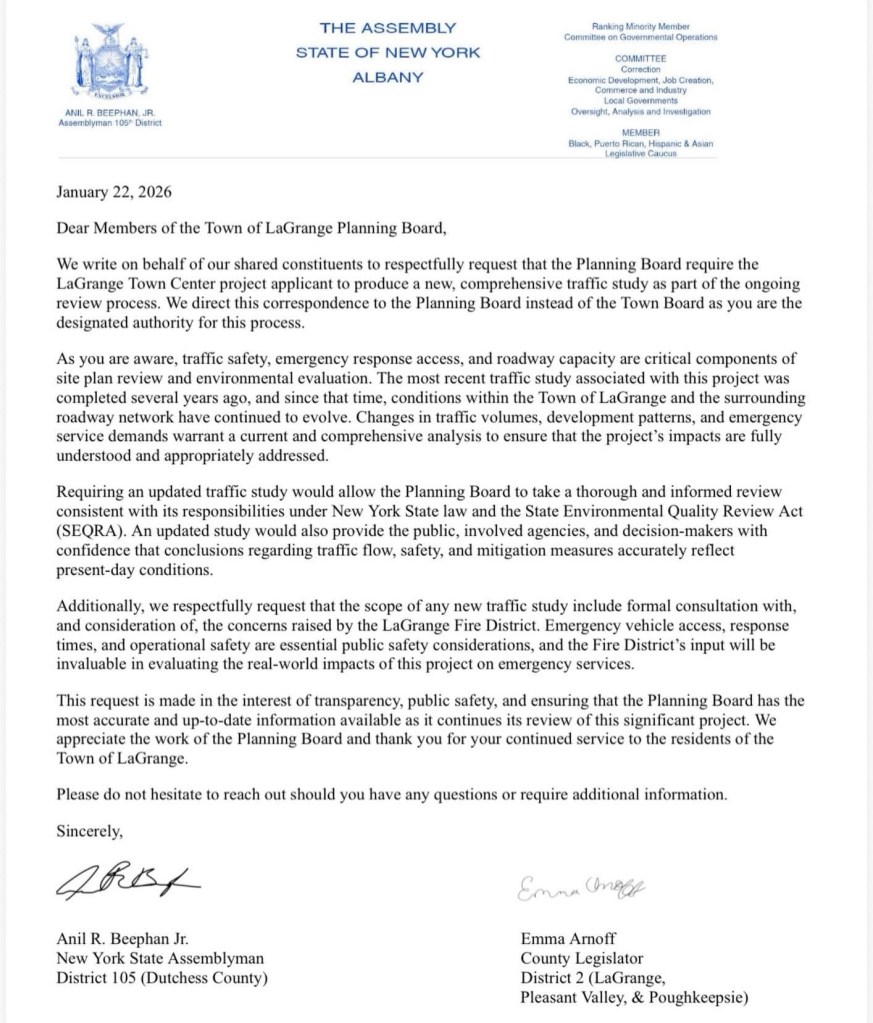
The Town of LaGrange, NY is represented in the Dutchess County Legislature by Emma Arnoff, a Democrat representing District 2, and Michael Polasek, a Republican representing District 3. The letter bears Arnoff’s signature. Polasek’s is absent.
That absence invites a narrower and more precise question than speculation about disagreement: was the District 3 legislator included in the effort at all?
In politics, omission is not always refusal. Sometimes it is choreography.
Letters like this are rarely drafted in open forums. They are written, circulated, and finalized within small and intentional circles. Decisions about who is included often occur before the first draft is shared, shaped by assumptions about responsiveness, alignment, or the likelihood of delay. Not being asked to sign can reflect anticipation—not of opposition, but of hesitation.
And hesitation, in local government, can be decisive.
If the District 3 legislator was not asked to join a request focused entirely on a major LaGrange development—its traffic impacts, emergency access, and SEQRA compliance—that fact alone is revealing. It suggests that unity was either assumed to be unattainable or deemed unnecessary. It implies parallel tracks of representation, where some officials engage directly with process while others are kept at a distance, intentionally or by habit.
Importantly, the letter itself does not oppose the project. It does not call for rejection or delay for delay’s sake. It asks for updated information—an updated traffic study reflective of current conditions and informed by the LaGrange Fire District. These are baseline governance requests, not ideological ones.
Which makes the absence more consequential.
If Polasek was asked and declined, constituents might reasonably want to understand why. If he was never asked, constituents are left with a different concern: that full representation was not even attempted at a moment when the town’s interests warranted a unified request.
Either way, the result is the same. One of LaGrange’s two county-level voices is missing from the official record.
In local government, transparency is not only about data and studies. It is also about inclusion—who is consulted, who is looped in, and who is invited to stand publicly behind the simple proposition that decisions should be based on current facts.
Sometimes the most telling detail is not conflict, but the quiet choice to avoid it.
 The Valley Viewpoint