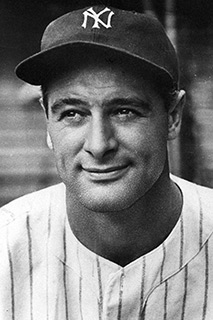
On this date, 78 years ago—in 1941—at 10:10 p.m. in a house located at 5204 Delafield Avenue in the Riverdale section of the Bronx, N.Y., a 37-year-old man died. This man died from a disease that robbed him of the ability to move, to run, to walk. He had suffered from it for about two years or so; it stole from him what mattered most to him: his livelihood and his avocation. The disease that ravaged him stole his gifts in the way an agile ballplayer stole bases, quickly and swiftly. Eventually, ironically and cruelly, the disease that claimed him in the end was named after him.
He died as he lived, quietly and with dignity. And when he died, not only did a whole neighborhood grieve, but a sports-mad city did as well. Indeed, one didn’t have to like baseball to suddenly stop and give pause to reflect not only on the man who was considered a great ballplayer but on the greatness of the man himself. That man was Lou Gehrig, who wore the legendary number 4 of the legendary New York Yankees. Seventy-five years is a long time; people—especially sports figures—come and go. Why bother to remember such long-ago events or people long faded from historical or popular memory? Why not? We ought to, because Lou Gehrig is worthy of remembering in a jaded age when fame and fortune seem to mean more than personal integrity, honesty and rectitude, values and traits that are nowadays just words in a dusty dictionary on an unused reference shelf.
Lou Gehrig was no showman or outsized personality in the way Babe Ruth was (as much as the fans liked him). No: He was unusual for his time, his place and his profession in that he took pride (of the non-vainglorious type) in what he was and what he did. (Even Hollywood recognized how special he was: Gehrig would be commemorated in the sentimentally popular movie with Gary Cooper in the starring role: 1942’s “The Pride of the Yankees.”)
He gave everything and everyone his respect and their due. The personal and professional lessons of his life went beyond baseball: He showed how to be an authentic human being, and that is why he is so important today. Lou Gehrig’s life story ought to be a primer for anyone in any profession, whether it be in athletics or even politics. Integrity and authenticity can never be faked and can never be bought: It can only be lived.
 The Valley Viewpoint